Pages

.

Stollen


If you ever walk into an East Asian American’s kitchen, chances are the oven is used for storing pots and pans because baking and roasting are just not part of our culinary traditions. I too was guilty of using my oven as storage for many years until I discovered my love for baking two years ago. To me, there’s nothing more satisfying than eating freshly baked bread made from scratch and it was all that more exciting when I baked my very own German stollen bread.

I’ve always been somewhat prejudiced against fruit cakes. That ultra-sweet candied dried fruit just isn’t my cup of tea. Much like the Moon cakes we have during the Moon Festival in Taiwan, not many people seem to really like it. But it’s a tradition, so we have it every year. But I felt completely different after that first bite of stollen bread. The perfectly sweetened dried fruit with a hint of rum fragrance was one of the most delicious fruit cakes I’ve ever had. I was determined to replicate the bread so I didn’t have to wait for Christmas time to have some. And most of all, they are a pretty pricy loaf of bread if you can even find them at your local bakery!

I have to admit, it took more than a few boxes of dried fruit and half a bottle of rum wasted before I was able to nail it. I’ve always said that the Germans make the best pastries; they take it very seriously, and they never fully reveal their secrets, which makes it that much harder to find decent German pastry recipes online.

And certainly my own recipe is far from the traditional stollen, which is very dense as it is cured and soaked in rum for two weeks. The recipe I’ve developed is fluffier and more like a brioche rather than a pound cake. It not only makes a great dessert, but will also make a great French toast for breakfast the next day!


Ingredients:


(Makes two loaves)
4 cups All-Purpose flour
12 cup almond meal
13 cup sugar
1 cup lukewarm whole milk
1 stick room temperature butter
214 tsp. instant dried yeast
1 egg
14 cup candied orange
34 cup golden raisins and currents, mixed 
12 cup sliced almonds
14 tsp. nutmeg
18 tsp. cardamom 
12 cup spiced rum
12 cup Confectioners sugar
6 to 8 oz. marzipan (optional)


Directions:

Start by soaking the golden raisins and currents in 14 cup spiced rum overnight.


To make the dough, start by mixing together the flour, yeast and almond meal. Add in the lukewarm whole milk and egg, kneed until all is combined. Now add in the room temperature butter and the pre-soaked dried fruit along with all the soaking liquid. Kneed for three minutes until the dough is smooth and elastic. Lastly, add in the sliced almonds and candied orange, kneed until all is combined.


Cover it up and let it rise in a draft-free warm spot for an hour until the dough has doubled in size .


On a floured surface, cut the dough in half and roll each piece out to about half an inch thick. If you so desire, place a log of marzipan in the center of the dough. The marzipan log is supposed to symbolize baby Jesus wrapped up in the blanket .


Fold the dough in half, leaving just a little edge in the bottom, and use a 11 x 17" pan lined with parchment paper. Press the dough gently with a rolling pin to seal it. Cover it up and let it rise for another hour.


Once the bread has almost doubled in size, bake it in a pre-heated 325 F oven for 45 minutes. If the top of the bread is browning too early, cover the top up with foil and continue to bake. To test if the bread is baked through, tap the bottom of the bread. If it sounds hollow, that means it’s ready.


While the bread is still warm, brush it generously with the remaining 14 cup rum.


Dust it well with icing sugar and wrap the bread with plastic wrap. Let it cure over-night to infuse all the flavors.


The next day you will have the most delicious bread that will surely impress your friends and family.


Happy holidays and enjoy!

reade more... Résuméabuiyad

Taiwanese Turkey Rice


In Taiwan, every city has its own specialty food. The southern Taiwanese city of Jia Yi is most know for its turkey rice, which originated sometime after World War II when the American military, which established a base there, imported turkey to feed the troops. Because Taiwan was a very poor country back then and there were limited protein resources, shredding the turkey into small pieces was the best way to get the most meal out of one small piece of meat. Street vendors started to add shredded turkey to stewed rice for added protein. Thus, the famous Jia Yi turkey rice was born. Nowadays it’s also very commonly served with chicken and is a very cheap and popular street food available in almost all noodle shops in Taiwan.

With Thanksgiving coming up this week, to me the best way to be thankful is to not be wasteful. From my experience celebrating Thanksgiving here in America, I’ve noticed there seems to be a lot of leftover turkey every year, and no one really seems to know what to do with it all the next day. While turkey toast and casseroles seem to be the most common uses for Thanksgiving leftovers, this year I thought I’d pitch a new option — Taiwanese Leftover Thanksgiving Turkey Rice!

Ingredients:

(serves 2 to 3 people)
3 cups cooked white rice
2 cups cooked turkey
6 shallots
14 cup vegetable oil
2 garlic cloves
2 scallions
3 slices of ginger
2 Tbsp. cooking wine
312 Tbsp. soy sauce
34 tsp. white pepper
1 tsp. sugar
18 tsp. Chinese five spice
34 cup water
14 tsp. salt or to taste
For the pickles:
1 cucumber
1 tsp. salt
1 Tbsp. rice wine vinegar
14 tsp. sugar

Directions:

Start by thinly slicing the shallots. In a large skillet, cook the shallots in 14 cup oil on medium high heat for 5 to 6 minutes until the shallots are golden brown and crispy. Strain the shallots, reserve the oil, then set aside. It’s very important that you start cooking the shallots before the oil has come to temperature. This way the shallots will cook gently and their flavor can be infused into the oil. I’ve been asked by someone before, What is the definition of Taiwanese food? The key ingredient to get that Taiwanese flavor is fried shallots. If a Taiwanese person walks into your house and you are frying shallots, chances are you will hear them say, “Smells like my grandmother’s kitchen!”


Roughly chop up the garlic, scallions and ginger. In a heavy sauce pan, heat up 1 tsp. of the shallot infused oil and cook the garlic, scallions and ginger on high heat. Cook for 30 seconds and then add in 2 Tbsp. cooking wine, 3 Tbsp. soy sauce, 14 tsp. white pepper, 1 tsp. sugar, 18 tsp. Chinese five spice and 34 cup water. Bring it up to a boil, then turn the heat down to low. Add in the fried shallots (reserve 2 Tbsp. aside for garnish) Let it simmer for an hour. If you have the bones from the leftover turkey, you may add them in as well, as this will intensify the turkey flavor .


Now shred up the 2 cup leftover turkey and toss it in 2 tsp. of the shallot oil along with 12 tsp. soy sauce, 12 tsp. white pepper and 14 tsp. salt or to taste. Set aside .


Traditionally, the turkey rice is served with Japanese pickled yellow daikon. You may find those in most Asian grocery stores. But to make things easier, I’m going to show you how to make a quick and simple cucumber pickle that goes really well with this dish. Start by thinly slicing the cucumbers, toss them in 1 tsp. salt and set aside. After 30 minutes, wash and drain the cucumbers, mix in 1 Tbsp. rice wine vinegar and 14 tsp. sugar.


Once the braised shallots are cooked it’s time to assemble the turkey rice


Serve the shredded turkey over some white rice, pour a ladle of the braised shallots over the turkey, sprinkle some fried shallot on top, and serve with the pickled cucumbers..


Happy Thanksgiving and enjoy!
reade more... Résuméabuiyad

Yien Shu Ji AKA Taiwanese Popcorn Chicken


Fried chicken is one of my guilty pleasures and I love exploring new recipes for the various versions of this beloved dish from around the world. So far in this column I’ve shared two of my favorite fried chicken recipes, from Korea and Thailand. But how can I forget the most delicious street food from my home country? So this week, it’s “yien su ji” (aka Taiwanese popcorn chicken).

The iconic fried chicken stand is ubiquitous in street markets across Taiwan. In addition to the little cubes of fried chicken thighs, yen su ji stands also feature a variety of meat and veggies like taro, bok choy, sweet potato fries, blood sausage, tofu, squid and fish cakes, as well as chicken hearts, livers, kidneys, anuses, gizzards, necks and feet. The vendor will fry the food and toss it in garlic, basil and a delicious blend of spices. For the sake of sensitive American palates, we’ll just stick to fried chicken for this recipe.

Ingredients:

(serves 2 to 3 people)
For the marinade:
2 cloves garlic
12 Tbsp. finely grated ginger
3-4 boneless chicken thighs
1 tsp. sugar
14 tsp. Chinese five spice 
12 tsp. white pepper
1 Tbsp. cooking wine
2 Tbsp. soy sauce
For the spice blend:
34 tsp. salt
12 tsp. white pepper
12 tsp. Chinese five spice
18 tsp. ground cinnamon
18 tsp. curry powder 
For toppings:
1 handful fresh basil 
2 cloves garlic
1 egg
14 tsp. baking soda
1 cup sweet potato starch
2 cups vegetable oil for frying

Direction:
Start by finely grating 2 cloves of garlic and ginger. Then cut the chicken thighs into bite-size pieces. In a bowl, mix in all of the marinade ingredients. Cover it up and let it marinate in the refrigerator for 30 minutes.


While you are waiting for the chicken to marinate, mix up the spice blend. You can also usually find the Taiwanese fried chicken spice blend at the Asian grocery store. For years I’ve been trying to make the spice myself and it always seemed to be missing something, but I’ve finally figured out the secret ingredient: curry powder.


Prep the toppings by washing and drying the basil and mince 2 cloves of garlic and set aside.

Once the chicken has been marinated, combine one egg with 14 tsp. baking soda and the marinated chicken thighs; mix well until combined.


Bread the chicken thighs in sweet potato starch. Try to find the coarse sweet potato starch, as most Taiwanese fried food is breaded in that for its distinctive texture. You can find coarse sweet potato starch in Asian grocery stores and possibly the local specialty food store. If you can’t find it, regular sweet potato starch or corn starch will work fine.


Preheat the vegetable oil to 350°F. To test if the oil is hot enough, here’s a little trick most Taiwanese do before frying food: Stick a chopstick in the pan and if the tip of the chopstick starts bubbling, that means the oil is hot enough to fry.


Fry the chicken in batches for 3 minutes for each batch. Set it on a cooling rack or paper towel.


Once all the chicken has been fried, now fry half of the basil and all the minced garlic for 15 seconds, quickly remove from the oil, or else they can burn really quickly. They may also splatter, so please be very cautious doing this step.

Now put all of the fried chicken back in the pan for the final frying. This will give the chicken an extra-crispy texture. Let it cook for a minute. Drain the excess oil and toss it in a bowl along with the remaining fresh basil as well as the fried basil, garlic and the spice blend .


Serve it while it’s warm. If you’d like to try these with a meatless option, fried tofu or mushrooms and even green beans are also really popular in Taiwan.


reade more... Résuméabuiyad


  • "America has just liberated itself from
    political correctness. The American people expressed their desire to
    remain a free and democratic people. Now it is time for Europe. We can
    and will do the same!" — Geert Wilders, Dutch
    MP, head of the Party for Freedom (PVV), and now on trial in the
    Netherlands for free speech.


  • "2016 is, by the looks of it, going to
    be the year of two great political revolutions. I thought Brexit was big
    but boy this looks like it is going to be even bigger." — Nigel Farage,
    MEP and leader of the UK Independence Party.


  • "The political class is reviled across
    much of the West, the polling industry is bankrupt and the press just
    hasn't woken up to what's going on in the world." — Nigel Farage.


  • "In a democracy, when the people feel
    ignored and despised, they will find a way to be heard. This vote is the
    consequence of a revolt of the middle class against a ruling elite that
    wants to impose what they should think." —
    Laurent Wauquiez, leader of the French opposition party The
    Republicans.


Donald Trump's electoral victory has come as a shock to Europe's
political and media establishment, which fears that the political sea
change underway in the United States will energize populist parties in
Europe.


Anti-establishment politicians, many of whom are polling well in a
number of upcoming European elections, are hoping Trump's rise will
inspire European voters to turn out to vote for them in record numbers.


Commenting on Trump's victory, Dutch lawmaker Geert Wilders, wrote:
"America has just liberated itself from political correctness. The
American people expressed their desire to remain a free and democratic
people. Now it is time for Europe. We can and will do the same!"


More than a dozen elections will be held in Europe during the next
twelve months, beginning with a re-run of the Austrian presidential
election scheduled for December 4. Polls show that Norbert Hofer, of the
anti-immigration Austrian Freedom Party, is on
track to win that race.


Also on December 4, Italians will vote in a referendum on reforming
the constitution. Observers say Trump's victory will make it more
difficult for Italian Prime Minister Matteo Renzi, one the few world
leaders publicly to endorse Hillary Clinton, to prevail.
They say Renzi's open support for Clinton will hurt Italy's relations
with the United States. Renzi has said he will resign if he loses the
referendum, which calls for curbing the role of the Senate. Most opinion
polls show the "no" camp ahead. Renzi says
the move will simplify decision-making, but opponents say it will
reduce checks and balances.


General elections are scheduled in 2017 for the Czech Republic,
France, Germany and the Netherlands, EU countries where
anti-establishment candidates are challenging the established order.


Mainstream politicians and the media have sought to discredit
populist leaders by branding them as neo-Nazi and xenophobic for their
opposition to mass migration, multiculturalism and the rise of Islam in
Europe. If Donald Trump can demonstrate that he is
able to govern the United States and produce tangible results,
especially by growing the economy and curbing illegal immigration,
Europe's political establishment will have a much harder time
stigmatizing dissenters.


Anti-establishment
politicians in Europe, such as Party for Freedom leader Geert Wilders
(left) in the Netherlands and UK Independence Party leader Nigel Farage
(right), have embraced Donald Trump and hope his
rise will inspire European voters to turn out to vote for them in
record numbers.


What follows is a selection of official European reactions to Trump's
election victory. Anti-establishment politicians have embraced Trump,
while establishment politicians have mostly issued pro forma
congratulatory statements that are polite but formal
and distant.


Austria. The leader of the Freedom Party, Heinz-Christian Strache, congratulated Trump on Facebook. He wrote:


"Little by little, the political left and the out-of-touch and
corrupt establishment is being punished by voters and driven from power.
This is a good thing, because the law comes from the people. The
Austrian mainstream media, which has been campaigning
against Trump for weeks and prematurely declared Hillary Clinton the
victor, were embarrassed by the voting public."


Belgium. The populist Vlaams Belang (Flemish Interest) party
congratulated Trump and said his unexpected election victory could be
repeated in Europe. Party chairman Tom Van Grieken tweeted:
"U.S. election shows again how far politicians are from the people." In another tweet, he wrote: "The rise of
Trump is not an isolated phenomenon. In Europe too, more and more voters want real change."


Britain. Prime Minister Theresa May said:


"I would like to congratulate Donald Trump on being elected the next
President of the United States, following a hard-fought campaign.
Britain and the United States have an enduring and special relationship
based on the values of freedom, democracy and enterprise.
We are, and will remain, strong and close partners on trade, security
and defense."


The leader of the UK Independence Party, Nigel Farage, who
successfully campaigned for the "Brexit" referendum for Britain to leave
the European Union, said Trump's victory did not surprise him. He tweeted:


"2016 is, by the looks of it, going to be the year of two great
political revolutions. I thought Brexit was big but boy this looks like
it is going to be even bigger."


He also tweeted: "I hand over the mantle to @RealDonaldTrump! Many congratulations. You have fought a brave campaign."


Speaking to ITV, Farage said: "The political class is reviled across much
of the West, the polling industry is bankrupt and the press just hasn't woken up to what's going on in the world."


Czech Republic. President Milos Zeman said Trump's election was a victory over "media manipulation." He said:


"I would like to cordially congratulate Donald Trump. I had, as one
of few European politicians, declared public support for this candidate
because I agree with his opinions on migration as well as the fight
against Islamic terrorism. I appreciate Donald
Trump's public demeanor. He speaks clearly, sometimes roughly, but
understandably, and avoids what is sometimes called political
correctness."


European Union. European Council President Donald Tusk wrote:


"Europe and the United States simply have no option but to cooperate
as closely as possible. I listened with attention to President-elect
Trump's call for American unity. And I, in turn, would like to call for
European and transatlantic unity. I do not believe
that any country today can be great in isolation. But I do believe that
America and Europe can, should and will work together. It is in our
common interest. We have to recognise that this will take major efforts
from both sides. The EU is a strong and reliable
partner and will remain so. We expect the same from America and its new
President."


France. President François Hollande tweeted: "The American people have expressed themselves. They elected Donald
Trump. I congratulate him. I am also thinking of Hillary Clinton."


The French Ambassador to the US, Gérard Araud, tweeted: "This is the end of an epoch. After Brexit and this vote anything is possible. The
world is crumbling in front of our eyes." He later deleted the tweet.


Former Prime Minister Dominique de Villepin said:
"What's happening in the US could happen in France."


Former Prime Minister Jean-Pierre Raffarin said:
"The boundaries of reason disappeared with Brexit, the main lesson for France is that Le Pen can win."


Laurent Wauquiez, leader of the opposition party The Republicans, said:
"In a democracy, when the people feel ignored and despised, they will
find a way to be heard. This vote is the consequence of a revolt of the
middle class against a ruling elite that wants to impose what they
should think."


The leader of the National Front party, Marine Le Pen, tweeted: "Congratulations to the new president of the
United States Donald Trump and the free American people!"


Le Pen's father, party founder Jean-Marie Le Pen, tweeted: "Today the United States, tomorrow France."


Germany. Chancellor Angela Merkel, who did not mention Trump by name, lectured the president-elect
on values:


"Germany and America are connected by values of democracy, freedom
and respect for the law and the dignity of man, independent of origin,
skin color, religion, gender, sexual orientation or political views. I
offer the next president of the United States
close cooperation on the basis of these values."


Vice Chancellor Sigmar Gabriel was less gracious. He said:


"Trump is the harbinger of a new authoritarian and chauvinist
international movement. He is also a warning for us. Our country and
Europe must change if we want to counter the authoritarian international
movement."


Foreign Minister Foreign Frank-Walter Steinmeier said:


"We hope that we are not facing greater instability in international
politics. During his campaign, Trump was critical not just of Europe,
but also of Germany. I believe we must prepare for American foreign
policy becoming less predictable. We must prepare
for a situation in which America will be tempted to make decisions on
its own more often.


"I do not want to sugarcoat it: Nothing will be easier and much will
be more difficult. Just as we Germans learned a lot in the past from our
American friends, we should now encourage our American friends to stay
true to past partnerships and to us."


Defense Minister Ursula von der Leyen said Trump's victory was "a big shock" and "not a vote for him
but rather against Washington, against the establishment." She added:


"Of course we Europeans, as a NATO ally, know that if Donald Trump
becomes president, he'll ask: What are you contributing to this
alliance? But we're also wondering, what's your position on this
alliance?"


Justice Minister Heiko Maas tweeted: "The world won't end. But it will get crazier."


The leader of the populist Alternative für Deutschland (AfD) party,
Frauke Petry, predicted that Trump's victory would result in a political
change in Europe too. On Facebook, she wrote:


"It was high time that in the United States of America, people who
feel disaffected withdrew their vote for the political establishment.
While 93% of voters in Washington, DC voted for Clinton in order to
retain their own power structures, the majority of
voters across the country want a political new beginning, an economic
recovery for the stricken middle class and an end of division in what is
still the most powerful country in the world.


"This election result is encouraging for Germany and for Europe,
because Trump really has the cards for political sea-change in his hand.
I congratulate Donald Trump on his election victory and on this
historic chance....


"Like Americans, citizens of Germany must have the courage to put a
tick in the ballot box and not remain complacent. Their opinion counts,
even if political correctness would appear to have elevated the decreed
consensus to the level of a new doctrine."


Beatrix von Storch, an AfD Member of the European Parliament, wrote:


"Donald Trump's victory is a clear signal that citizens of the
Western world want political change. This is a surprise only to the
establishment. In the USA as well as Germany, citizens wish for secure
borders, less globalism, and politics that focus with
common sense on issues in their own country."


Hungary. Prime Minister Viktor Orbán wrote on Facebook:
"What great news. Democracy is still alive."


Italy. The founder of the anti-establishment 5-Star Movement, Beppe Grillo, hailed Trump's victory. He wrote:


"This is proof that these millions of demagogues are not the people,
they are journalists, intellectuals, anchored to a world that no longer
exists. There are similarities between these events in America and our
movement.... We are going to govern and they
will ask: 'But how did they do it?' They channelled the collective
anger."


The Netherlands. Dutch lawmaker Geert Wilders said:


"America regained its national sovereignty, its identity, it reclaimed its own democracy, that's why I call it a revolution.


"Now there is a leader, despite all the negativity spread about him
by the political elite and the press, that has only one concern, and
that is the national interest of the voters of America who are concerned
about immigration, who are concerned about the
job loss as a result of globalization, who are concerned about the
Islamization of their society. And he tends to say the truth and
convince people that if they start moving, anything is possible, and I
believe the historical event of yesterday will have an
enormous effect on European politics as well.


"The lesson for Europe is, what America can do we can do as well."


In an essay published by Breitbart, Wilders wrote:


"Yesterday, the American people made it quite clear that they do not
want to follow in Western Europe's footsteps. They do not want to give
their country away. They want to preserve their nation, their freedoms,
their prosperity. They felt the time for liberation
had come.


"The American voters no longer want to be represented by politicians
who do not take their concerns seriously. They felt Donald Trump was the
only one who listens to them....


"America has just liberated itself from political correctness. The
American people expressed their desire to remain a free and democratic
people. Now it is time for Europe. We can and will do the same!"


Soeren Kern is a Senior Fellow at the New York-based Gatestone
Institute
. He is also Senior Fellow for European Politics at
the Madrid-based Grupo de Estudios Estratégicos / Strategic Studies
Group. Follow him on
 Facebook and
on
 Twitter.


reade more... Résuméabuiyad

Tu Dou Si ( Shaanxi Sour & Spicy Shredded Potato)


During our trip back to Taiwan last spring, one of my prime objectives was to visit a certain Northern Chinese cuisine restaurant in Taipei. The owner and chef of the restaurant is from the Shaanxi province of China, which is a fascinating place. It neighbors Inner Mongolia, Ganxu, Sichuan and Ningxia, which includes a large population of Chinese Muslims. Shaanxi province’s capital city, Xi’an, is one of the four great ancient capitals of China and is the eastern terminus of the Silk Road, which leads to Europe, the Arabian Peninsula and Africa. With so many diverse people moving throughout the region over the centuries, Shaanxi’s culture and cuisine is particularly distinct from what we typically think of as “Chinese food.” 

Because of Shaanxi’s northern location, wheat and potatoes are a staple food. One of the most delicious dishes we had at the restaurant was stir-fried shredded potato. As simple as it sounds, its texture and flavor is nothing like any potato dish I’ve ever had before. Both my mom and I were determined to make this dish. And in the end, my mom won the contest by perfectly recreating the same texture and flavor as we had in the restaurant. So this week I’d like to share with you my mother’s recipe for this famous Shaanxi Sour & Spicy Shredded Potato. Being the end of the harvest season, many of us have a lot of potatoes stored in the root cellar. This will really spice up your potato dishes this winter!


Ingredients:

2 russet potatoes
1 cup cold water
13 cup rice wine vinegar
114 tsp. salt
1 scallion, finely chopped
1 hot pepper, finely chopped
112 Tbsp. oil

Directions:

Cut potatoes into thin sticks; rinse and drain the water. Try not to use the shredder and cut by hand instead, or else the potatoes will get overcooked and you won’t get the crunchy texture. 

In a large skillet on medium-high heat, toss in the potatoes, oil and salt, and stir-fry for one minute. Add in the rice wine vinegar.


After that, pour in the water in batches, about 1/4 cup at a time. Cook until all liquid is cooked down. This will take about three to four minutes. 


Remove from stove and mix in chopped scallions and hot pepper. Now it’s ready to serve!


This makes a delicious side dish that will complement a heavy, meat-based meal. 
reade more... Résuméabuiyad


  • Should Americans uphold the Judeo-Christian values, which have governed Western civilization until now? Or should they quietly allow the defeat of those values by a false liberalism -- false, because it is anything but liberal -- which will allow values, such as that of Islamic sharia religious law to settle over the United States? Will people willingly surrender their own culture in order to avoid becoming victims of intimidation?


  • Worse, these policies often come in the seemingly benign-sounding terms of "diversity", "multiculturalism", "peace", "anti-racism", and "human rights"; but are often used in an Orwellian way to mean their own opposites. "Diversity" means, "It is great to look different so long as you think the same way I do" and is also an acceptance of Islamic values. "Anti-racism" often means, in a racist way, anti-white or anti-Jew. "Human rights" now means a political agenda. "Peace" is used to mean the destruction of Israel. "Multiculturalism" means any culture except the Judeo-Christian one -- regardless of whether that culture supports denigrating women, slavery, flogging, amputating limbs, murdering gays and the intolerance of all other religions and cultures. These inversions of language are having devastating consequences not only on university campuses, but also throughout the U.S. and abroad.


  • "The process of settlement is a 'Civilization-Jihadist Process' with all [that] the word means. The Ikhwan [Muslim Brotherhood] must understand that their work in America is a kind of grand jihad in eliminating and destroying the Western civilization from within and 'sabotaging' its miserable house by their hands and the hands of the believers..." -- Muslim Brotherhood, 1991.


  • The question of whether to submit to these policies, as Europe is doing, or to uphold freedom, as Israel is doing, has arrived in the United States. The choice Americans make will immeasurably affect not just the US, but, despite sounding melodramatic, the future of Western civilization.


For the American voter, issues of immense urgency to the survival of the free world -- such as individual freedom, dispassionate enquiry and freedom of speech and thought, which we dangerously have come to take for granted -- are being derailed by crude language and behavior, when Americans need to be paying attention to serious threats to the United States, its allies and to the values of the West.

Internationally, these threats come from Iran, Russia, China, North Korea, and countless terrorist groups.

Domestically, they appear in the form of massive corruption -- financial and otherwise -- that is visibly hollowing out American institutions, such as the FBI (the failure to follow investigative procedure, followed by calls for FBI Director James Comey's resignation); the Department of Justice (the "Fast and Furious" gun-walking scandal, and the Attorney General meeting with a former president whose wife is under investigation); the State Department (email leaks are still yielding up evidence of collusion between the Clinton Foundation and the State Department under Hillary Clinton); the IRS (targeting conservative non-profits, and raiding the businesses of private citizens, who disagree with policy); the Environmental Protection Agency's attempt toacquire power over every puddle in America) and the Executive branch in the "I have a pen and I have a phone" president's dealings with Iran.

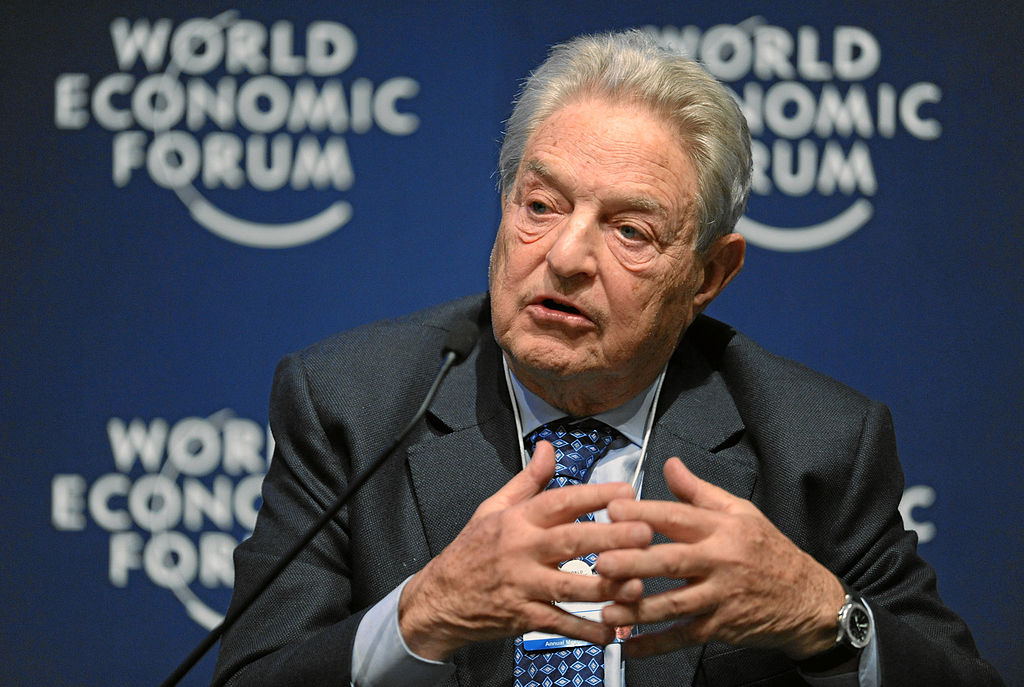
There have also been attempts by outsiders to incite racial and religious anarchy. The entrepreneur George Soros, for example, donated $33 million to turn events in Ferguson, Missouri from a local protest into chaos.


There have been attempts by outsiders to incite racial and religious anarchy. The entrepreneur George Soros, for example, donated $33 million to turn events in Ferguson, Missouri from a local protest into chaos. (Image source: World Economic Forum)


Instead of helping Americans to create a safer, more prosperous way of life, the Ferguson events destroyed a community, devastated small business owners, and eroded security, the rule of law, and any hope for a better future. Who benefits? Creating chaos embeds a political dependency: rather than helping people to climb out of poverty, it keeps them voting for politicians to "rescue" them.

Jews and Israel are also targeted -- often, regrettably, by other Jews, who appear naïvely to hope that they will thereby "immunize" themselves from attacks on Jews. Recently, for example, an article accused the U.S. Republican presidential election campaign of "significantly enhancing the presence of antisemitism in the public arena."

Seriously?

While "conservative" radicals, such as white supremacists do exist, they are not even close to overtaking the mainstream discourse. That space, rather, seems to have been filled in the last decades by self-described "liberals" who now seem to dominate it to such a degree that the Dean of Students at the University of Chicago, John Ellison, felt obliged to write a letter warning prospective applicants not to expect a "safe space." "Conservative" radicals are not the ones hunting down Jews -- "liberals" and Islamists are victimizing and shutting them out.

Ironically of course, the liberals have not yet figured out that the agendas of these two groups are incompatible (as in gender equality); perhaps they are trying to "immunize" themselves, too.

Public debate in the US, particularly in the next few weeks, really needs to be about choosing what policies would actually improve the lives of Americans. Should they uphold the Judeo-Christian values, which have governed Western civilization until now? Or should they quietly allow the defeat of those values by a false liberalism -- false, because it is anything but liberal -- which will allow values, such as that of Islamic sharia religious law to settle over the United States? Will people willingly surrender their own culture in order to avoid becoming victims of intimidation?

American university campuses, which should proudly be championing debate of all ideas, have instead been rife with antisemitism for years, mostly because a "thought police" obsessed with identity politics -- another way of saying my race, religion, skin color or sexual proclivity is good, yours is not -- has overtaken campuses and turned them into embittered war-zones. It is postmodern Stalinism.

Worse, these policies often come in the seemingly benign-sounding terms of "diversity", "multiculturalism", "peace", "anti-racism", and "human rights"; but are often used in an Orwellian way to mean their own opposites. "Diversity" means, "it is great to look different so long as you think the same way I do" and is also and acceptance of Islamic values. "Anti-racism" often means, in a racist way, anti-white or anti-Jew. "Human rights" now means a political agenda. "Peace" is used to mean the destruction of Israel. "Multiculturalism" means any culture except the Judeo-Christian one -- regardless of whether that culture supports denigrating women, slavery, flogging, amputating limbs, murdering gays and the intolerance of all other religions and cultures. These inversions of language are having devastating consequences not only on university campuses, but also throughout the U.S. and abroad.

The glue that brings "liberals" and Islamists, such as the Muslim Students Association (MSA) in the US (a front[1] for the Muslim Brotherhood), together in a common cause is the goal of eradicating Israel -- of course always only under the euphemisms of "helping Palestinians" and "Peace," even though Jihadi camps for children were organized first by Palestinians.

A 1991 official document authored by the Muslim Brotherhood outlines its strategic goals for civilizational jihad in North America. It depicts the Muslim Brotherhood's plans for civilization jihad in the United States stating:


"The process of settlement is a "Civilization-Jihadist Process" with all [that] the word means. The Ikhwan [Muslim Brotherhood] must understand that their work in America is a kind of grand jihad in eliminating and destroying the Western civilization from within and "sabotaging" its miserable house by their hands and the hands of the believers... [W]e must possess a mastery of the art of "coalitions", the art of "absorption" and the principles of "cooperation."

The question of whether to submit to these policies, as Europe is doing, or to uphold freedom, as Israel is doing, has arrived in the United States. The choice Americans make will immeasurably affect not just the US, but, despite sounding melodramatic, the future of Western civilization.


Judith Bergman is a writer, columnist, lawyer and political analyst.


[1] In a 1991 official document authored by the Muslim Brotherhood, outlining its strategic goals for civilizational jihad in North America, the Muslim Students Association was mentioned as "one of our organizations and the organizations of our friends", that is, a front group for the Muslim Brotherhood. The document was entered as evidence in the 2008 Holyland Terror Funding Trial.


© 2016 Gatestone Institute. All rights reserved. The articles printed here do not necessarily reflect the views of the Editors or of Gatestone Institute. No part of the Gatestone website or any of its contents may be reproduced, copied or modified, without the prior written consent of Gatestone Institute.


reade more... Résuméabuiyad